

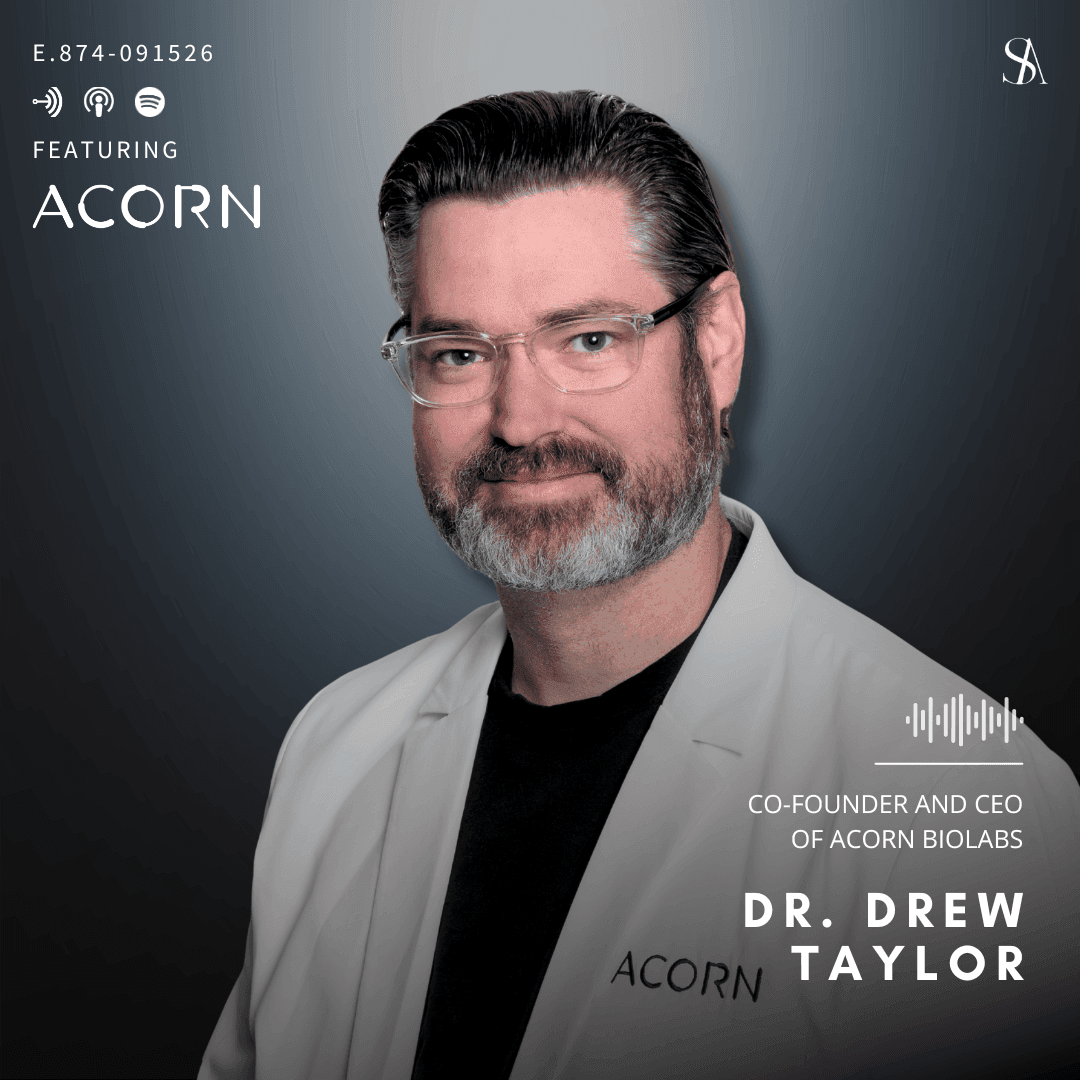
Dr. Drew Taylor, biomedical engineer and CEO of Acorn, joins Skin Anarchy to demystify regenerative aesthetics: what a secretome actually is, why exosome counts can mislead, whether older cells still work, and why banking your own cells early may matter.
Who is Dr. Drew Taylor?
A biomedical engineer who took a winding path through pro baseball. He played in the Blue Jays and Phillies organizations while earning a PhD at the University of Toronto, studying how a patient's own stem cells regenerate connective tissue. "I really do feel like I'm doing what I'm supposed to be doing."
What is a secretome?
The full set of molecules cells release to signal and repair. Taylor stresses the root word is secretion, not secret. "That entire secreted population of things is the secretome." It includes exosomes plus free growth factors, matrix molecules like hyaluronic acid and collagen, binding proteins, cytokines, and PDRN, an orchestra rather than one instrument.
What is the difference between a secretome and exosomes?
Exosomes are the delivery vehicle; the secretome is everything being delivered. Taylor compares exosomes to Amazon packages that unbox themselves inside your cells. "The exosome itself is not the signal, it's the contents of the exosome." The secretome captures those contents plus the free molecules that travel outside exosomes.
Do older cells still work for regenerative treatments?
Yes, with the right process. Older cells produce the same molecules at lower efficiency, so collecting their output over time builds potent volumes. "You're able to actually offset about 85% of the loss over a 30 year period of age difference," Taylor says, noting patients as old as 87 have seen results from their own secretome.
What is the problem with donor exosomes?
Expansion ages them fast. To treat many patients from one donor, cells are multiplied repeatedly, a photocopy of a photocopy. "We're basically taking decades worth of aging in the human body and fast forwarding through that in a matter of weeks." He cites work showing donor cells from young children can end up performing like ones decades older.
Does the number of exosomes in a product matter?
Far less than the contents. Taylor points to research showing that after the fourth passage, exosomes lose regenerative power even though their count stays the same. "Advertising on a number of exosomes means very little." One product boasting a trillion exosomes, he notes, held a fraction of the protein his secretome does.
Can regenerative treatments really reduce wrinkles?
Yes, but by stimulating tissue, not filling it. In clinical work Taylor reports reversal of fine lines and even shallowing of deeper folds. "We're actually stimulating your tissues to perform at a higher level." He is clear this is not filler and not instant. "Regenerative medicine is a long game."
Why bank your cells early?
Because there is only one of you, and cells age with every division. Acorn captures cells noninvasively by plucking scalp follicles rather than harvesting bone marrow. Taylor frames it as "your biologic health insurance policy," preserving your youngest biology before time and demand degrade it.
Where is regenerative medicine headed?
Toward rapid acceleration. Taylor compares the field to early flight: decades to become useful, then supersonic and lunar within years. "Right now in the world of regenerative medicine, we're crossing the Atlantic," with trials in hair, skin, orthopedics, and fertility.
Listen to the full episode with Dr. Drew Taylor of Acorn on Skin Anarchy, available wherever you get your podcasts.