


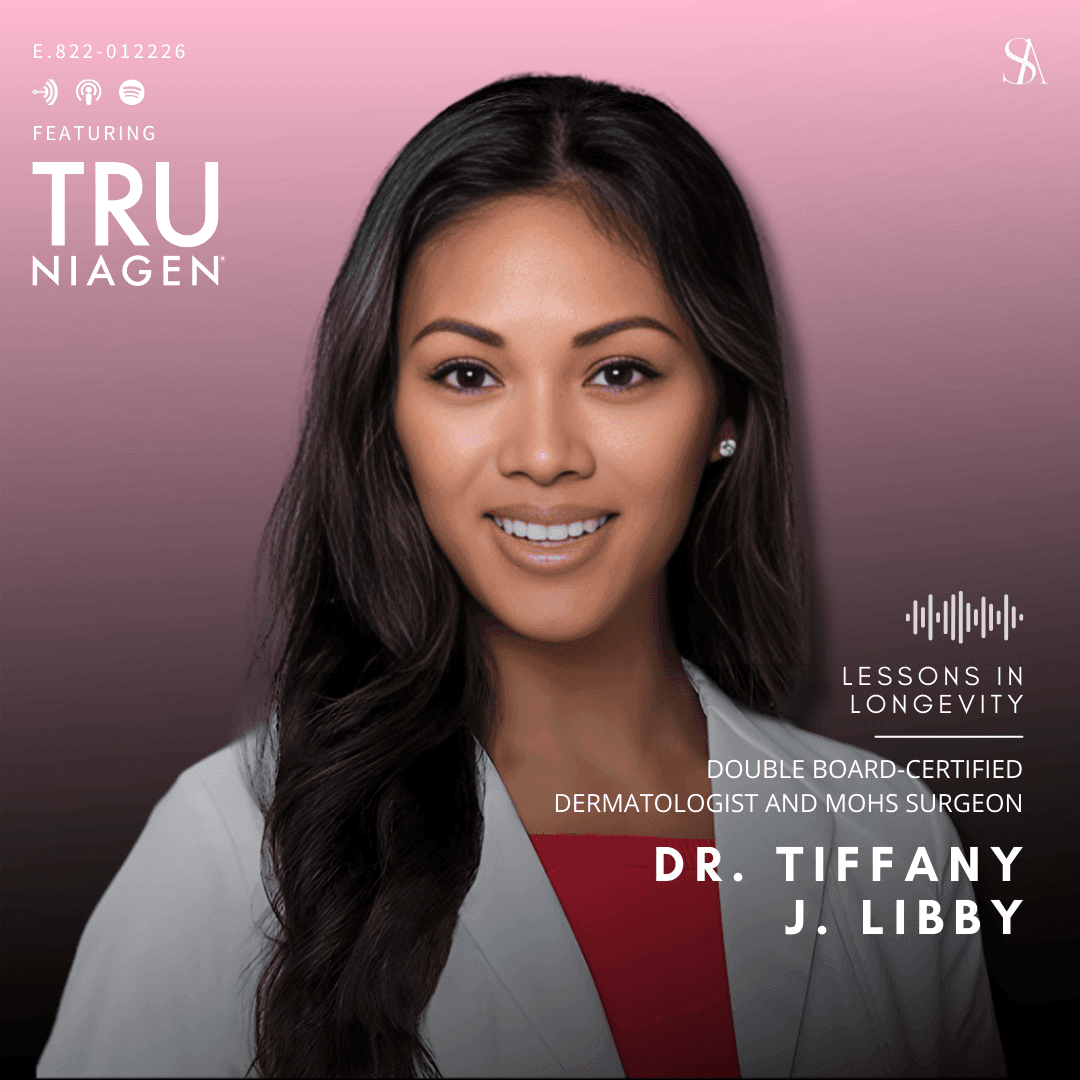
In this episode of Skin Anarchy, Dr. Ekta Yadav sits down with board-certified dermatologist Dr. Tiffany Libby for a deep, science-driven conversation on supplements, cellular energy, and the growing public interest in NAD optimization. As part of the podcast’s longevity programming, the discussion explores how NAD biology intersects with skin health, systemic wellness, and realistic expectations around supplementation — cutting through hype with clinical clarity
From Dermatology to Longevity Thinking
Dr. Libby’s interest in longevity medicine is deeply personal. Raised in a medical household and now serving as Director of Mohs Surgery at Brown University Health, her career spans both high-stakes skin cancer care and cosmetic dermatology. Treating patients from their thirties into their nineties has shaped her understanding of the difference between lifespan and healthspan — especially after witnessing the long-term consequences of autoimmune disease treatment within her own family. That experience reframed longevity not as an abstract concept, but as a question of resilience, function, and quality of life over decades.
Why Supplements Are Having a Moment
As awareness around aging biology grows, many patients arrive asking about supplements — especially NAD boosters — as potential interventions. Dr. Libby explains that this surge reflects a systemic gap in U.S. healthcare, which prioritizes treatment over prevention. Supplements often appeal because they promise agency in a system that rarely invests in proactive health. Still, she cautions against viewing any supplement as a shortcut. Longevity rests on foundational pillars: sleep, nutrition, exercise, stress regulation, and inflammation control. Supplements, if used, should support — not replace — those fundamentals.
Understanding NAD at the Cellular Level
NAD (nicotinamide adenine dinucleotide) is essential for mitochondrial function, cellular energy production, and DNA repair. Dr. Libby explains NAD through a practical lens: mitochondria are the power plants of the cell, and NAD is critical fuel that keeps those systems running. As we age, NAD levels decline — by as much as 65% between ages 30 and 70 — leaving cells less capable of producing energy or repairing damage. In skin, this decline affects collagen synthesis, barrier integrity, DNA repair from UV exposure, and long-term cancer risk.
Why the Precursor Matters More Than NAD Itself
A central clarification in the episode focuses on how NAD levels are actually increased. NAD itself is a large, charged molecule that cannot cross cell membranes. Instead, cells rely on precursors — most notably nicotinamide riboside (NR) — to synthesize NAD internally. Dr. Libby explains why NR is currently the most well-studied and bioavailable option.
She highlights Tru Niagen, whose patented NR ingredient (NIAGEN®) has been evaluated in more than 40 human clinical trials and is used in independent research at institutions such as Harvard and Mayo Clinic. Studies show that consistent NR supplementation can significantly raise intracellular NAD levels — demonstrating true cellular uptake rather than theoretical benefit.
Skepticism, Safety, and Supplement Oversight
Both Dr. Ekta and Dr. Libby emphasize that skepticism is essential — particularly in an underregulated supplement industry. Without FDA oversight equivalent to pharmaceuticals, product quality can vary widely. Dr. Libby explains that one reason she aligned with Tru Niagen was its commitment to third-party testing, transparency, and independent verification — not only of its own products, but of competitor formulations as well. This focus on toxicology, dose accuracy, and bioavailability is critical when introducing compounds intended to influence cellular metabolism.
What NAD Optimization May Mean for Skin
From a dermatologic perspective, improved NAD availability supports processes fundamental to skin health: collagen and elastin synthesis, barrier lipid production, DNA repair, antioxidant defense, and microbiome stability. Dr. Libby explains that mitochondrial efficiency underpins all of these functions. When cellular energy declines, skin becomes thinner, drier, less resilient, and more vulnerable to photoaging and disease. Supporting NAD levels does not reverse aging — but it may help skin function closer to its biological potential over time.
Beauty From Within, Without False Promises
The conversation also explores the idea of “beauty supplements” as complementary tools. New formulations combining NR with skin-supportive ingredients — such as astaxanthin, hyaluronic acid, biotin, and vitamin E — are positioned as adjuncts, not replacements, for topical skincare. Dr. Libby emphasizes a layered approach: internal support paired with evidence-based skincare and realistic expectations.
Mitochondria, Prevention, and Aging Forward
Rather than focusing on reversing damage, this episode reframes longevity as optimization — supporting upstream cellular pathways that influence downstream outcomes. Mitochondrial health, fueled in part by adequate NAD availability, plays a role in how skin defends against UV radiation, manages inflammation, and maintains structural integrity over time. These processes are preventive by nature, aiming to slow decline rather than undo it.
Biomarkers, Data, and Clinical Caution
The discussion also addresses biomarkers and the growing trend of extensive blood testing. Dr. Libby urges restraint: testing without clear intervention pathways can create anxiety without improving outcomes. While biomarkers can offer insight, the science has not yet caught up to widespread consumer interpretation. Longevity data must be contextualized, clinically guided, and grounded in causation — not correlation.
A Science-First Approach to Longevity
This episode reinforces a core Skin Anarchy theme: longevity is not about chasing youth, but about supporting biology with rigor, humility, and evidence. NAD science offers meaningful insight into cellular aging — but only when paired with foundational health practices and scientifically validated tools.
Listen to the full episode of Skin Anarchy to hear Dr. Tiffany Libby explain the science behind NAD, mitochondrial health, and why true longevity begins with supporting cellular function — not shortcuts.