


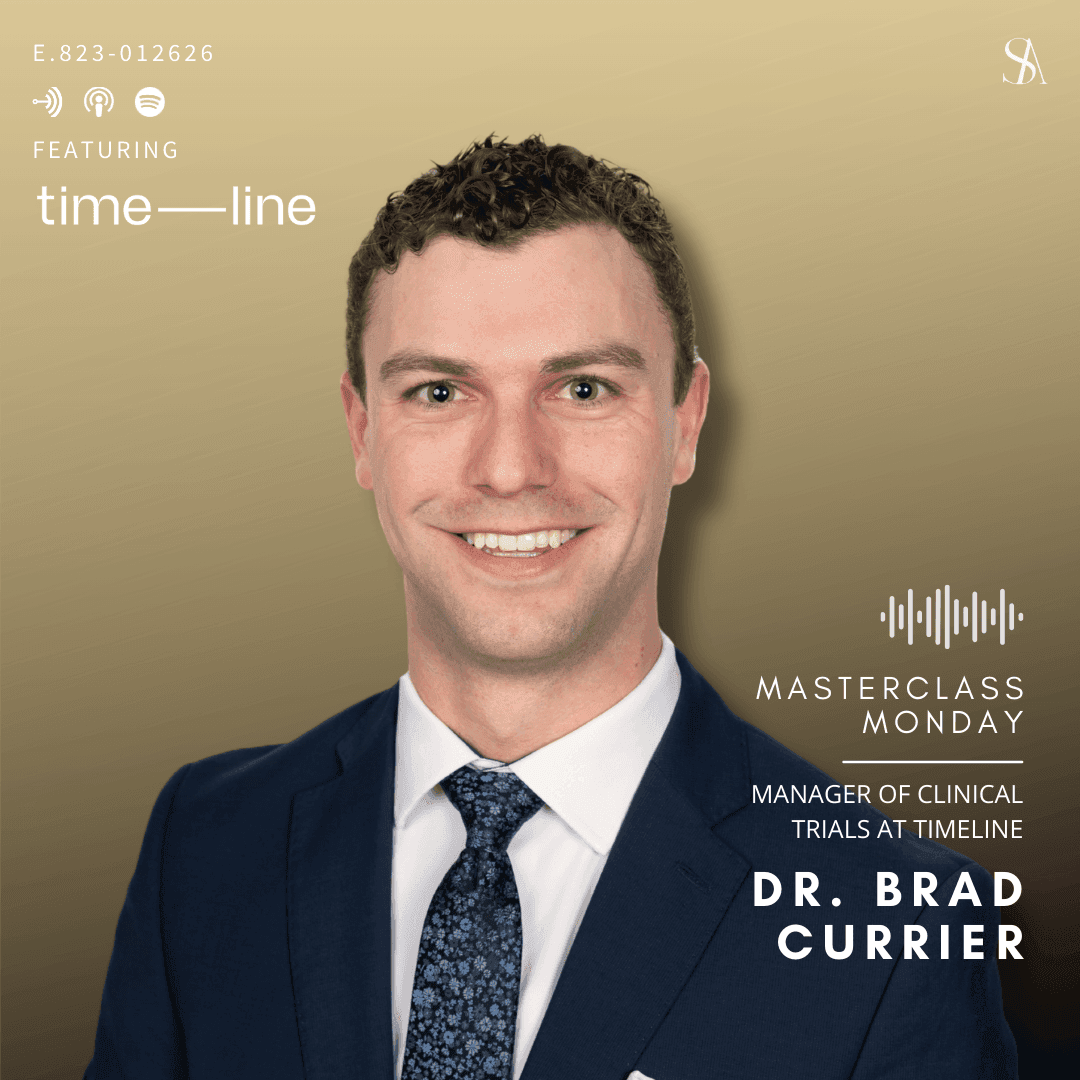
In the third episode of the Skin Anarchy x Timeline Masterclass series, Dr. Ekta Yadav sits down with Dr. Brad Currier, Manager of Clinical Trials at Timeline, for a deep dive into the science behind clinical validation, mitochondrial health, and what real evidence in longevity skincare should look like.
With a background in muscle physiology, exercise science, and aging research, Dr. Currier brings a rare systems-level perspective to longevity — one that bridges performance science, metabolism, and cellular biology. His journey from studying elite athletic performance to running aging-focused clinical trials reflects a shift from optimizing peak performance to improving long-term healthspan at scale.
Why Muscle, Skin, and Mitochondria Are Longevity Organs
A central theme of the conversation is the overlooked parallel between muscle and skin as longevity-critical organs. Muscle, which accounts for roughly 40% of body mass and drives the majority of metabolic rate, plays a foundational role in aging resilience. Skin, the body’s largest organ, mirrors this importance — not only structurally, but biologically.
Both tissues are mitochondria-dense, meaning cellular energy production, repair capacity, and metabolic efficiency strongly influence how they age. Rather than treating skin aging as purely cosmetic, the episode reframes it as a physiological process shaped by underlying cellular health, muscle integrity, and mitochondrial function.
Timeline’s Scientific Foundation: From Urolithin A to Human Trials
Dr. Currier explains that Timeline’s longevity platform is built on more than 15 years of research into urolithin A, a postbiotic derived from polyphenols found in foods like pomegranates and berries. Long before the molecule entered skincare, preclinical studies showed its ability to enhance mitochondrial function, laying the groundwork for later human trials.
Rather than relying on trend-driven marketing, Timeline pursued a mechanism-first research model, validating mitochondrial benefits in muscle before expanding into skin. This translational pipeline — from cellular biology to human efficacy — allowed the brand to anchor claims in biological causation rather than surface-level correlation.
Why Clinical Trials Matter More Than Marketing Claims
One of the most important insights in the episode centers on why clinical trials are essential — not as a marketing tool, but as a confidence engine. According to Dr. Currier, clinical trials answer a fundamental question: How certain can we be that something actually works?
He highlights a major issue in the beauty and skincare industry: many brands rely on self-reported perception claimsinstead of objective, quantifiable outcomes. In contrast, rigorous trials measure real biological or structural change — such as wrinkle depth, hydration metrics, or barrier function — allowing consumers to evaluate evidence rather than anecdotes.
The conversation also addresses systemic gaps in cosmetic regulation, where pre-registration of trials, standardized endpoints, and publication requirements are not mandatory. Dr. Currier emphasizes that brands committed to scientific integrity voluntarily adopt pharmaceutical-level research practices, including publishing results and disclosing methodologies.
The Challenge of Testing Topicals — and Why Most Brands Fall Short
Testing topical skincare presents unique scientific hurdles. Unlike pharmaceuticals, there is no universal standardized protocol for evaluating topical efficacy, creating opportunities for bias, selective reporting, or underpowered studies.
Cost, technical expertise, trial duration, and methodological rigor often determine whether brands pursue meaningful research — or cut corners. Dr. Currier explains that high-quality trials require intentional design, predefined endpoints, and measurable clinical relevance, which many companies avoid due to time or financial constraints.
For consumers, the takeaway is clear: not all “clinical studies” are equal, and published, peer-reviewed, human data should be considered the gold standard.
What Timeline Actually Measures: Wrinkles, Barrier Function, and Hydration
Timeline has completed 12 clinical trials across its skincare portfolio, evaluating hallmark aging endpoints such as wrinkle depth, skin hydration, and barrier integrity. Rather than vague cosmetic claims, these studies quantify structural and functional improvements.
Across multiple trials, products have demonstrated approximately 10–30% reductions in wrinkle severity over one to two months, depending on study design and duration — figures that exceed industry-typical benchmarks. Eye cream performance, in particular, showed notable efficacy in improving wrinkle depth, reinforcing the clinical relevance of mitochondrial-focused formulations.
Mitobiotic Skincare: Nourishing the Cell’s Energy System
A defining concept in the episode is Timeline’s positioning as a “mitobiotic” brand — a term reflecting the idea that humans are living ecosystems whose mitochondria also require nourishment.
From a mechanistic standpoint, Timeline conducted biopsy-based studies to examine how urolithin A impacts human skin at the molecular level. Early findings revealed upregulated collagen synthesis and improved collagen organization, providing direct evidence that mitochondrial support can enhance skin structure and matrix integrity, not just surface appearance.
This mechanistic validation allowed later trials to shift toward lower-burden, real-world efficacy outcomes — ensuring studies remain both scientifically meaningful and ethically considerate for participants.
Measuring Mitochondria Without Overburdening Human Participants
Dr. Currier addresses the technical challenge of studying microscopic organelles like mitochondria in living humans. While biopsies allow direct cellular analysis, they are invasive and not always necessary once mechanisms are established.
Timeline’s strategy evolved from mechanistic cellular research to phenotypic outcome trials, focusing on visible and functional improvements such as barrier strength, hydration, and wrinkle reduction. This approach prioritizes scientific insight while respecting participant burden, ensuring trials remain ethical, purposeful, and impactful.
Why Human Skin Data Matters More Than Petri Dish Promises
Dr. Ekta underscores a major industry problem: overreliance on in vitro studies that fail to translate into real-world human results. The episode reinforces a core Skin Anarchy philosophy — longevity science must be tested in real human biology, not theoretical lab models.
Timeline’s commitment to human clinical data across every marketed product positions it as an outlier in a market often dominated by buzzwords, proprietary ingredient naming, and underpowered evidence.
Longevity as Precision, Not Hype
Rather than treating longevity as a vague marketing umbrella, the episode reframes it as a precision discipline rooted in cellular function, mitochondrial health, and clinically measurable outcomes. In an era where consumers are increasingly science-literate, the conversation calls for higher standards, deeper transparency, and biologically grounded claims.
Listen to the full episode of Skin Anarchy to hear Dr. Brad Currier break down the science behind mitochondrial health, clinical trials, and what real evidence-based longevity skincare should look like.